Who This Blog Is For: Anyone in the Vancouver, WA area — from Salmon Creek and Felida to Camas and out toward Ridgefield — who has noticed that sitting is no longer neutral. The drive across the bridge into Portland leaves you stiff for the rest of the day. A few hours of spring yard work ends with you stretched out on the floor wondering how it got this bad again. You have probably tried adjusting your chair, your posture, your pillows — and the back pain when sitting keeps finding you anyway. If that pattern has been going on for months, or quietly for years, this is written for you.
Does your back feel fine when you are moving around — and then tighten the moment you sit down for any length of time? Have you started mentally mapping rest stops on drives to the coast, or noticed that a long afternoon in the yard leads to a rough next morning? And have you found yourself wondering why stretching helps in the moment but never quite resolves the underlying problem?
You are not imagining the pattern. Back pain that reliably worsens with sitting is one of the most common complaints we hear at Balanced Living Chiropractic — and one of the most misunderstood.
Most people assume it is a posture problem, a muscle problem, or simply the cost of getting older. Sometimes those things play a role. But when the pain keeps returning with the same reliability, the same location, and the same stubbornness regardless of what you do to manage it, your spine may be pointing toward something structural that has never been fully addressed.
With spring and summer road trips coming up, longer days pulling people outdoors, and the natural uptick in activity that the Pacific Northwest season brings, this is exactly the time of year when positional back pain tends to announce itself loudly.
This blog is our attempt to explain what is actually happening — and why the answer may start further up your spine than you would expect.
Quick Answer: Back pain that reliably worsens when sitting typically indicates that the spine is carrying an uneven mechanical load. Because sitting compresses the vertebrae and limits the body's ability to self-correct, any existing structural imbalance becomes magnified, turning a normal seated position into a painful stress test for the spine.
When the spine is structurally balanced, sitting for extended periods might feel uncomfortable, but it remains manageable. Your muscles eventually tire, you shift your position, and the passing discomfort clears up relatively quickly once you stand.
However, when there is an underlying misalignment in the spinal foundation, sitting forces the body to endure a constant structural strain it is simply not equipped to handle. The resulting pain isn't random; it is your spine communicating that an imbalance is actively being exposed by the downward pressure of sitting.
For many people in the Vancouver area, this exact pattern quietly builds across months or years of daily commuting, desk work, and weekend road trips. The Columbia River Gorge is only an hour away, the Oregon coast is two, and Mt. St. Helens is even closer.
While these aren't extreme driving distances, for someone whose spine is already overcompensating, even a short hour in the car can trigger two days of painful recovery. That frustrating cycle deserves a real explanation, not just another set of temporary stretches.
There is a particular quality to back pain from long drives that most people recognize immediately — it is deeper, slower to resolve, and seems to radiate in ways that ordinary muscle soreness does not.
A drive up Highway 14 along the Columbia, a weekend trip to Cannon Beach, or even a longer haul down I-5 to Eugene can leave someone feeling like they need several days to fully recover. That experience is not exaggeration. It reflects something specific about what sustained static posture does to a spine that is already under structural stress.
When you drive, your spine is held in a fixed position for an extended period while simultaneously absorbing road vibration and subtle postural shifts.
For a structurally balanced spine, this is manageable.
For a spine that is already compensating for misalignment higher up, it is compounding stress on joints and nerves that are already working harder than they should be.
The deep, lingering quality of post-drive back pain is often a sign that the spine's compensation pattern has been pushed past its tolerance threshold.
This is also why sitting back pain relief that works at home — heat, gentle stretching, lying flat — tends to only go so far after a longer drive.
The muscles relax, but the structural load pattern does not change. By the next morning, the same joints are carrying the same uneven weight, and the cycle begins again.
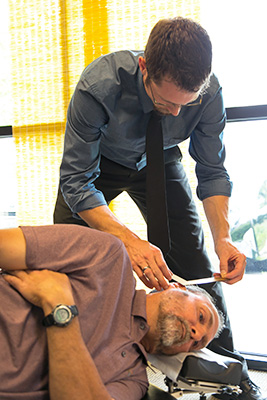
What Dr. Perin and Dr. Wulff offer at Balanced Living Chiropractic begins with a thorough structural evaluation — one that looks at the spine as a connected system rather than a collection of isolated complaints.
As NUCCA-trained practitioners, they use precise imaging and measurements to identify whether a shift at the atlas is creating the kind of compensation pattern that could be driving positional back pain. The process is gentle, specific, and grounded in objective data rather than generalized adjustment.
NUCCA care — the approach used at our Vancouver WA chiropractic office — is a precise, measurement-guided method within upper cervical care that focuses on restoring the structural relationship between the skull, atlas, and the rest of the spine.
When that relationship is corrected, the compensation patterns that have been accumulating below it often begin to resolve.
For many patients, this is the first time a provider has looked at the structural foundation as a potential contributor to their back pain — and the relief that follows can feel different in quality from anything they have experienced with approaches that addressed only the lower back.
We want to be honest about outcomes: upper cervical care does not guarantee a specific result, and every person's spine and history are different.
What we can say is that for patients whose back pain is tied to a structural compensation pattern, addressing that pattern at its origin — rather than managing it downstream — frequently produces more lasting sitting back pain relief than symptom-focused approaches alone.
There is a particular kind of quiet loss that comes with positional back pain. It is not dramatic enough to explain to people, but it shapes every decision. You pick the shorter drive. You skip the spontaneous afternoon at Cape Disappointment. You cut the yard work into smaller sessions and spend the evening paying for what you did manage to get done. You have probably stopped mentioning it to people because there is nothing new to say — it just keeps coming back.
Dr. Joe Perin and Dr. Vanessa Wulff at Balanced Living Chiropractic in Vancouver WA work with people throughout Clark County — from Camas to Ridgefield to Battle Ground — who have been managing this kind of pain for months or years without ever finding a lasting answer. Find out if you are a candidate for upper cervical care.
Schedule your consultation with our Vancouver WA chiropractors today!

Why does my back pain always seem to spike on longer drives but feel manageable on short ones?
Duration matters because the spine can temporarily compensate for positional stress. Short drives stay within that tolerance window. Longer drives push past it — especially if there is an underlying structural imbalance already loading the spine unevenly. The deeper, slower-to-resolve quality of post-drive pain is often a sign that the system has been stressed beyond what compensation can absorb.
I've had this pattern for years. Does that mean the problem is too far gone to address?
Not at all. Many patients who come to Balanced Living Chiropractic have been managing positional back pain for five, ten, or even twenty years. The duration of symptoms does not determine whether a structural root cause can be identified and addressed — it simply means the pattern has had more time to become familiar. Longer history often means more relief is possible once the underlying issue is corrected, not less.
I notice my back pain is worse in the morning after a day of sitting. Why does it follow that delay?
The delayed onset pattern — feeling it the next morning rather than immediately — reflects how the body processes accumulated mechanical stress. During activity and even during sleep, muscles and joints continue responding to the strain pattern established during the day. When the structural load is uneven, that overnight processing often amplifies rather than resolves the discomfort.
Can a problem at the top of my spine really affect my lower back?
This surprises many people, but it is central to how upper cervical care understands back pain. The atlas sits at the top of the spine and plays a significant role in how the entire spinal column organizes itself beneath it. A shift at that level causes the spine to compensate downward — and the lumbar region, carrying the most mechanical load, often shows the most visible symptoms. The lower back is frequently where the consequences land, not where the problem originates.
To schedule a consultation with Dr. Joe Perin, call our Vancouver office at 360-569-1740. You can also click the button below.

If you are outside of the local area, you can find an Upper Cervical Doctor near you at www.uppercervicalawareness.com.