Who the Blog is For: If your jaw aches and you've wondered how jaw clenching and TMJ are connected, this is for you. Maybe you've cut back on caffeine, caught yourself clenching at your desk, or tried a night guard — and the tension still comes back. Like a lot of people around Vancouver, you've handled the obvious things and just want to understand the part that usually gets overlooked: what's happening a little higher up, in your neck.
You catch yourself doing it again — teeth pressed together over one more email, shoulders creeping up. Your jaw is already sore, your temples tight. You relax it, and for a while you do, until the next deadline or the next crawl across the Interstate Bridge, and you're clenched again. A jaw that feels tense to move when you talk or eat can be exhausting and frustrating to deal with. It especially becomes a burden when the pain follows you into your daily routine, into sleep, and even during special moments with your family.
But thankfully, it may be possible to unlock relief. Find out more about jaw clenching and TMJ and how you can address it by getting your atlas bone checked.
Quick Answer: Jaw clenching and TMJ often stem from several factors a dentist or physician evaluates — muscle-driven jaw strain, disc or joint issues, arthritis, and bite problems — with stress-related clenching and grinding adding daily load. A commonly overlooked contributor is the upper neck, whose alignment helps set the resting tension in the muscles that move and stabilize the jaw.
When people ask what links jaw clenching and TMJ, they want one clean answer. But "TMJ" is shorthand for the temporomandibular joint and the issues that can affect it, so why your jaw hurts depends on what's driving it.
A dentist or physician looks first at the recognized factors: muscle-driven strain, disc or joint problems inside the joint, arthritis, and bite or alignment issues with the teeth. Clenching and grinding — often called bruxism — sit alongside these, adding repeated load day after day.
Everyday triggers are the spark, not the underlying reason. A stressful week, hours at the screen, too much caffeine, or disrupted sleep can each set off a bout of clenching — which is why easing one trigger can quiet things yet leave the door open for the next flare.
The commonly overlooked contributor is the upper cervical spine, at the top of the neck. When those top vertebrae sit slightly out of alignment, the muscles running between the neck, skull, and jaw can carry more resting tension than they should, which may make the jaw quicker to clench and slower to release.
Your body is built to adapt. When the upper neck holds a small misalignment, the muscles around your head, neck, and jaw adjust to keep your head level and your bite comfortable — a little extra tension here, a shift in posture there, changes you never chose.
In the short term, they help. Over months and years, though, they keep those muscles working harder than they should, with less chance to rest. Add repeated clenching on top of that baseline, and the joint rarely gets a real break — less a sudden injury than a system quietly under steady load. That's often why the soreness builds gradually and then settles in.

Left unaddressed, these compensation patterns reinforce themselves. One muscle group tightens, a neighbor picks up the slack, and the jaw settles into a higher resting tension that makes clenching easier to fall back into. For some people, this is why teeth grinding and TMJ in Vancouver can feel like a cycle that never fully closes — even after they've cut back on caffeine, worn a night guard, and tried to catch themselves clenching.
None of this means stopping the care you already have. Night guards, dental care, physical therapy, and stress management all have their place, and many people benefit from them. The point is simply that when the cycle keeps resetting, the structural piece — how the upper neck and jaw share the load — is worth evaluating too, because it's easy to miss on a standard workup.
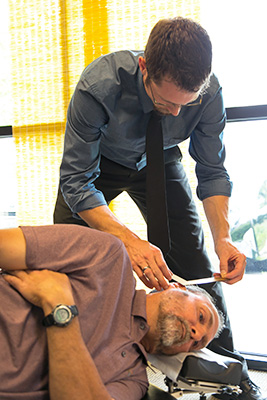
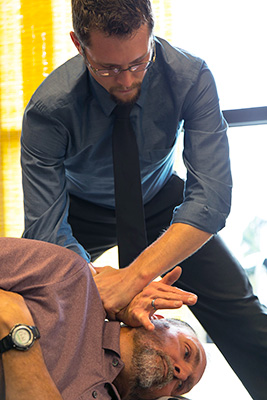
Upper cervical care in Vancouver WA focuses narrowly on the alignment at the top of the neck and how it relates to your posture and muscle tension. At Balanced Living Chiropractic, the doctors use the NUCCA method — a precise, imaging-guided, low-force approach that maps your individual anatomy before any gentle correction. There's no twisting or cracking.
The aim isn't to chase the clench itself but to support the structure so the muscles around your jaw have less baseline tension to work against. Many people who come looking for a TMJ chiropractor in Vancouver WA find that upper cervical care for jaw tension in Vancouver fits alongside the dental and medical care they already receive — adding to it, not replacing any part of it.
If your jaw keeps tightening no matter how much you ease off, the most useful next step is to stop chasing each flare and look at what's feeding the pattern. At Balanced Living Chiropractic in Vancouver, Dr. Joseph Perin and Dr. Vanessa Wulff offer a gentle evaluation to see whether your alignment is part of the story — and whether addressing it sooner may ease the cycle.
Schedule your consultation with our chiropractors in Vancouver WA today!
Is it normal to clench my jaw when I'm stressed?
It's very common. Many people clench or grind during focused work, stressful stretches, or sleep, often without realizing it. Occasional clenching isn't unusual, but when it's frequent enough to leave your jaw sore, it's worth having both the dental and structural pieces looked at.
Can jaw clenching contribute to TMJ problems?
It can add to them. Repeated clenching and grinding place ongoing load on the temporomandibular joint and the muscles around it, which may make existing jaw issues more noticeable. It's usually one factor among several, alongside the bite, joint, and muscle considerations a dentist or physician evaluates.
How would I know if my jaw tension is connected to my neck?
Clues can include a past head or neck injury, lingering neck stiffness, headaches that start at the base of the skull, or jaw tension that persists even after you've addressed the obvious habits. None of these confirms a neck link on its own, but together they're worth noticing. A focused upper cervical evaluation, which looks at alignment and posture rather than only the jaw, is the clearest way to find out.
Does upper cervical care replace seeing my dentist about TMJ?
No. It's meant to work alongside your dental and medical care. Your dentist evaluates the bite, the joint, and options like night guards; upper cervical care simply looks at the structural contributor in the upper neck that many workups overlook.
Is upper cervical care a safe option for jaw tension?
The NUCCA approach uses gentle, low-force corrections guided by imaging rather than forceful twisting. As with any care, an evaluation comes first to determine whether you're a good candidate before anything is done.
Should I keep wearing my night guard if I clench?
If your dentist has fitted you with one and it helps, there's usually no reason to stop. Upper cervical care isn't a substitute for a night guard — the two can complement each other, one protecting the teeth while the other looks at the structural pattern.
What's the difference between bruxism and a TMJ disorder?
Bruxism is the habit of clenching or grinding the teeth. A TMJ disorder refers to problems with the jaw joint and its surrounding muscles. They often overlap — repeated bruxism can add strain that contributes to jaw-joint issues — but a dentist or physician can help tell them apart.
To schedule a consultation with Dr. Joe Perin, call our Vancouver office at 360-569-1740. You can also click the button below.

If you are outside of the local area, you can find an Upper Cervical Doctor near you at www.uppercervicalawareness.com.