"But the MRI was normal..." Those four words. You've probably heard them more times than you can count since your accident. And every time, you feel that familiar mix of relief and frustration wash over you. Relief because there's no tumor, no bleeding, no scary emergency. But frustration because you KNOW something's still wrong with you.
The world still tilts when you stand up too fast. You grip the handrail going down stairs because you don't trust your balance anymore. Your family keeps asking if you're feeling better, and you smile and nod because what else can you say? How do you explain that you feel disconnected from your own body?
You're not crazy. You're not being dramatic. And you're definitely not alone.
We've sat across from hundreds of patients who've told us this exact story—people who've been to every specialist, tried every medication, and still can't shake that awful feeling that their world has shifted off its axis since their head injury.
Here's what we've learned: sometimes the most important healing happens in places traditional medicine isn't designed to look.
When we tell patients that their dizziness might be coming from their neck, we usually get some puzzled looks. But here's what happens during a head injury that most people don't realize...
Picture your head sitting on top of your neck like a bowling ball balanced on a pencil. When trauma occurs—whether it's a car accident, sports injury, fall, or even what seems like a "minor" bump—your head doesn't just get jolted. The delicate bones at the very top of your neck, the atlas (C1) and axis (C2), often shift out of their normal position.
Now, these aren't just any old bones. They sit right next to your brainstem, which is basically mission control for your balance, coordination, and a whole lot of other vital functions. Even a tiny misalignment here can irritate the nerves and blood vessels that help keep you steady on your feet.
Look, we have tremendous respect for emergency medicine and neurology. They do incredible work, especially in those critical first hours and days after a head injury. But here's where things can fall through the cracks...
Standard imaging like CT scans and MRIs are fantastic at spotting fractures, bleeding, or major structural damage. What they're not designed to catch are those subtle misalignments in the upper cervical spine—shifts that might only be a few millimeters but can create significant problems for your nervous system.
We often tell patients: "Just because nothing showed up on your MRI doesn't mean nothing's wrong. It might just mean we need to look at this differently."
Post-traumatic dizziness can show up in all sorts of ways:
What's particularly frustrating for our patients is that these symptoms can come and go. You might feel fine for days, then have a terrible dizzy spell that lasts for hours. This inconsistency often makes people (and sometimes their doctors) wonder if it's "all in their head."
It's not. We've seen this pattern hundreds of times.
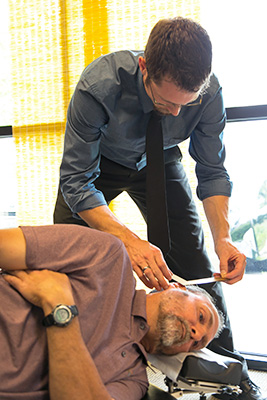
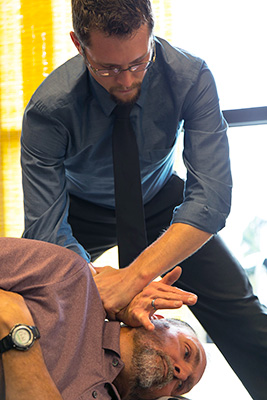
NUCCA in Vancouver WA is a precise, gentle approach that focuses specifically on those top two bones in your neck. We're not talking about the typical chiropractic adjustments you might be picturing. It is low-force and precise, making it a great options for young and old people and patients with severe pain.
Our Vancouver WA chiropractors, Dr. Perin and Dr. Wulff use detailed X-rays and measurements to understand exactly how your atlas and axis have shifted. Then they apply a very specific, light pressure to encourage these bones back into their proper position. Most patients are surprised by how gentle it is—some even ask if we actually did anything.
But here's what happens when we restore proper alignment to your upper neck:
We're going to be completely honest with you about something: healing isn't always linear, and it definitely isn't always fast.
Some patients walk out of our office after their first adjustment and contact us the next day saying they feel dramatically better. Others need weeks or months to see significant changes. A few need ongoing maintenance care to keep feeling their best.
We often see patients who've been dealing with post-concussion symptoms for months or even years after accidents. Initially, many don't notice dramatic changes after their first few adjustments, but then around week 4 or 5, something shifts. The constant background dizziness that had been their unwelcome companion suddenly isn't there anymore.
What really strikes us about these cases is that it's rarely just the dizziness that improves. Sleep gets better. Concentration returns. Headaches that have been persistent since the injury start spacing out, then disappear entirely.
That's the thing about the brainstem—it controls so many functions that when you help it work properly again, all sorts of unexpected improvements can happen.
We hear this phrase constantly: "I guess this is just my new normal."
No. Stop. Full stop.
Just because it's been months (or years) since your injury doesn't mean this is how you have to live forever. Just because other treatments haven't worked doesn't mean nothing will. And just because the medical system has essentially shrugged at your symptoms doesn't mean you have to shrug too.
Your body is remarkably resilient. Your nervous system wants to heal. Sometimes it just needs the right conditions to do what it's designed to do.
Living here in Vancouver, we know you're tough. Pacific Northwest people don't complain unless something's really wrong. You've probably been pushing through, making accommodations, adjusting your life around your symptoms since your concussion. You've gotten really good at managing, haven't you?
But managing isn't thriving. And you deserve better than just getting by.
Many Vancouver WA chiropractors focus on general spinal health, but when you're dealing with the complex aftermath of head trauma and persistent dizziness, you need someone who understands the intricate connection between your upper cervical spine and your neurological symptoms.
We've worked with people from all walks of life who couldn't return to work because they couldn't trust their balance anymore. Teachers who had to quit because they couldn't handle the fluorescent lights and busy classrooms. Athletes who gave up sports they'd played their whole lives because their coordination was affected.
And we've also helped many of these same types of patients get back to the lives they thought they'd lost forever.
Here's how we help our patients at Balanced Living Chiropractic:
First, we listen. Really listen. We want to hear your story—not just the medical facts and your symptoms or health complaints, but how these have affected your life. What you've had to give up. What you're afraid you'll never get back. The fears you haven't told anyone else.
Then, if it seems like NUCCA might be the right fit, we'll take some very specific X-rays. These aren't like the ones you've had before—we're looking for precise measurements of the topmost neck bones.
If we find what we suspect—that subtle misalignment at the top of your neck—we'll explain exactly what's happening and what we think we can do to help. And if we don't think we can help you, we'll tell you that too. We'd rather refer you to someone who can than waste your time and money.
Look, we know you've been disappointed before. We know you've gotten your hopes up only to have another dead end. We can't promise that NUCCA will be your answer, but we can promise you this: if we take you on as a patient, it's because we genuinely believe we can help.
Your dizziness started when your head trauma disrupted the delicate balance at the top of your spine. Maybe—just maybe—fixing that disruption is the key to getting your life back.
You've been patient enough. You've been strong enough. You've managed long enough.
Isn't it time to see if you can actually heal?
Ready to explore whether NUCCA can help with your post-traumatic dizziness? Contact Balanced Living Chiropractic in Vancouver, WA to schedule your consultation with Dr. Joe Perin and Dr. Vanessa Wulff.

How soon after a head injury can I seek NUCCA care?
We typically recommend waiting until you've been cleared by emergency medicine or your primary care doctor for any serious injuries. Once you're medically stable, NUCCA care can be pursued at any time—whether it's been weeks, months, or even years since your injury. We've helped patients who've been dealing with post-traumatic symptoms for decades.
How is NUCCA different from regular chiropractic care for head injuries?
NUCCA focuses specifically on the precise alignment of your top two neck vertebrae using detailed X-ray analysis and mathematical calculations. The corrections are extremely gentle and specific to the atlas bone. This specificity is crucial when dealing with post-traumatic symptoms because the brainstem area requires such delicate care.
Can NUCCA help with other symptoms I've had since my head injury?
Many patients report improvements in related symptoms like headaches, sleep problems, concentration difficulties, and neck pain. This happens because the upper cervical area affects so many neurological functions. However, we evaluate each patient individually and never promise specific outcomes—every case is unique.
How many NUCCA treatments will I need for my dizziness?
This varies significantly depending on factors like the severity of your injury, how long you've had symptoms, and your body's healing response. Some patients notice improvements within a few visits, while others may need ongoing care over several months. We'll give you a better sense of expectations as we look into your case and monitor your progress.
To schedule a consultation with Dr. Joe Perin, call our Vancouver office at 360-569-1740. You can also click the button below.

If you are outside of the local area, you can find an Upper Cervical Doctor near you at www.uppercervicalawareness.com.