Who This Blog Is For: If balance and dizziness with age have become part of your everyday — a hand on the counter when you stand, a careful pause at the top of the stairs — this is for you. It's for people around Vancouver who've noticed themselves growing less sure on their feet and don't want to just write it off as getting older, and for the families who've watched a parent start to move more cautiously and wondered what's behind it.
It's the small hesitations that tell you something's changed. You rise from a chair and wait a beat for the room to settle. You reach for a handrail you used to ignore. On an uneven sidewalk, you catch yourself watching your feet. For a while it's easy to fold into the story of getting older — until a near-stumble catches you off guard and you realize how much energy you spend just staying steady. When staying upright takes that much attention, it's worth asking whether something more than age is in play. Often, there is.
Quick Answer: Balance and dizziness with age usually come from several changes a physician evaluates together — inner-ear conditions like BPPV, blood-pressure shifts, medication side effects, and changes in vision or sensation. A commonly overlooked contributor is the upper neck, which is dense with position sensors that feed your balance system, so its alignment can affect how steady you feel.
When people ask what causes balance and dizziness with age, the honest answer is usually more than one thing at once — which is why it can be so hard to pin down. A physician looks first at the recognized contributors: inner-ear conditions such as BPPV (very common later in life), shifts in blood pressure when you stand, side effects of medications that stack up over the years, and gradual changes in vision, hearing, and sensation in the feet. Each can chip away at steadiness on its own, and often several overlap.
The everyday moments you notice — a wave of unsteadiness when you stand up quickly, turn your head, or step onto uneven ground — are the spark, not the deeper cause. They're the moments your balance system gets caught a half-step behind.
The commonly overlooked contributor sits at the very top of the neck. This small region is unusually dense with position sensors that constantly tell your brain where your head is in space. When those upper vertebrae sit slightly out of alignment, or the muscles around them stay tense, the signals they send can become less consistent — and because your balance depends on clear input from this area, that can quietly add to the unsteadiness.
Your body is built to adapt. When the upper neck holds a small misalignment, the muscles around your head and neck adjust to keep your eyes level and your head balanced over your shoulders — small compensations you never chose. In younger years, a healthy balance system absorbs those adjustments easily.
With age, the other systems you rely on for balance — the inner ear, vision, the sensation in your legs and feet — naturally become a little less sharp. When one input is already working from inconsistent signals, the whole system has less margin. That's part of why balance problems and dizziness in Vancouver can build gradually and then take hold — less a single cause than several systems with less room to spare.
Some dizziness needs prompt medical attention, especially as we get older. Seek urgent care for a fall that caused a head strike or injury, dizziness that comes on suddenly and severely, or dizziness with chest pain, a pounding or irregular heartbeat, fainting, sudden weakness or numbness, trouble speaking, or new vision or balance loss. New or worsening dizziness after a change in medication is worth a prompt call to your physician or pharmacist. Upper cervical care is for the ongoing, everyday unsteadiness once serious causes have been ruled out — never a substitute for urgent care or a proper fall-risk assessment.
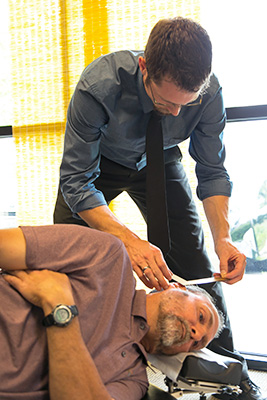
Upper cervical care takes a whole-structure view of balance that begins where your head meets your spine — the small, sensor-rich region that feeds so much information to your balance system. At Balanced Living Chiropractic, the doctors use the NUCCA method: a precise, imaging-guided, low-force approach that maps your individual alignment before any gentle correction.
The aim isn't to chase each dizzy moment but to give your balance system clearer, steadier input to work from. Many older adults looking into upper cervical care for dizziness in Vancouver find it fits naturally alongside the medical care and fall-prevention steps they're already taking.
If balance and dizziness with age have you moving through your days more carefully than you'd like, the most useful next step is to look at every piece of the picture — including the one at the top of your neck. At Balanced Living Chiropractic in Vancouver, Dr. Joseph Perin and Dr. Vanessa Wulff offer a gentle evaluation to see whether your alignment is part of why you feel unsteady.
Schedule your consultation with our chiropractors in Vancouver WA today!
Is dizziness just a normal part of getting older?
Dizziness in older adults in Vancouver WA is common, but common isn't the same as unavoidable. Some changes in balance do come with age, yet dizziness usually has specific, identifiable contributors worth sorting out rather than accepting. A physician can check the medical causes, and an upper cervical evaluation can look at the structural piece.
Could my medications be making me dizzy?
It's possible, and it's worth reviewing. Several common medications — and especially combinations of them — list dizziness or lightheadedness among their effects. Never stop a prescription on your own, but do ask your physician or pharmacist to review your list. That review pairs well with looking at the structural contributors to balance.
How is upper cervical care different from balance exercises or vestibular therapy?
They work on different pieces and fit well together. Balance exercises and vestibular therapy train your system to adapt and compensate; upper cervical care looks at the quality of the position signals coming from the top of your neck in the first place. Many people do both.
I've fallen a couple of times — should I be worried?
Falls are worth taking seriously, especially more than one. Let your physician know, since repeated falls call for a proper fall-risk assessment to check vision, blood pressure, medications, and strength. Alongside that, an upper cervical evaluation can look at whether unsteady position signals from the neck are part of the picture.
Is an upper cervical adjustment safe for older adults?
The NUCCA approach is gentle and low-force, guided by imaging rather than any forceful twisting or cracking, which is part of why many older adults are comfortable with it. As always, an evaluation comes first to see whether you're a good candidate and to tailor anything that's done.
Can better neck alignment really affect my balance?
It can play a part. The top of the neck is unusually rich in sensors that tell your brain where your head is, and that information feeds your balance system. When those signals are less consistent, steadiness can suffer — so alignment in this area is one reasonable thing to check.
Will this help if my dizziness comes from my inner ear, like BPPV?
Inner-ear conditions like BPPV are managed by your physician, and upper cervical care doesn't replace that. What it can do is look at a separate structural contributor to balance that sometimes overlaps with inner-ear issues. The two are considered side by side, not one instead of the other.
Can a family member come with me to the evaluation?
Absolutely, and many people find it helpful. A spouse or adult child can help share what they've noticed, remember the details afterward, and be part of the plan. You're welcome to bring someone with you.
To schedule a consultation with Dr. Joe Perin, call our Vancouver office at 360-569-1740. You can also click the button below.

If you are outside of the local area, you can find an Upper Cervical Doctor near you at www.uppercervicalawareness.com.