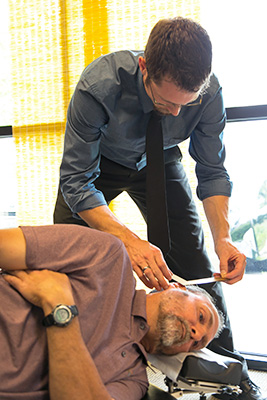
Who This Blog Is For: If a migraine with neck pain is your usual pattern — the tightness at the base of your skull, there hours before the headache itself — you already know the two aren't really separate. This is for people around Vancouver who've managed the headache, stretched the neck, and still feel both return together, and who want to understand what ties them.
It often starts in your neck. A tightness at the base of your skull, a heaviness behind your eyes, and you already know where the afternoon is headed. By the time the migraine sets in, your neck is stiff enough that turning your head hurts too — and when the worst finally passes, your neck stays sore, bracing, slow to settle. When this is your pattern month after month, it's fair to wonder whether the neck and the migraine are two problems or one. More often than not, they're closer to one than they look.
Quick Answer: Migraine with neck pain usually reflects how closely the head and upper neck are wired together — the nerves that carry neck and head pain share pathways, so an attack often brings both. A physician evaluates the migraine and related headache types; a commonly overlooked contributor is the alignment of the upper neck, which can keep that shared tension elevated.
When people ask what links a migraine with neck pain, they assume the neck pain is just tension from bracing against the headache. Sometimes it is. But for most people who live with migraine, the neck is part of the attack itself — an early signal, not a side effect.
Here's why: The nerves from the upper neck and the nerve that carries most head pain share the same pathways, so the signals converge — an upper-neck issue can register as head pain, and a migraine can leave the neck sore and stiff.
A physician or neurologist looks first at the recognized picture: migraine as a neurological condition, plus related patterns like cervicogenic headache (headache that stems from the neck) and tension-type headache.
Everyday triggers are the spark, not the underlying reason. A long stretch at the screen, a poor night's sleep, or a jaw that clenches through the day can each tip you into an episode — which is why easing one trigger helps for a while yet leaves the pattern intact.
The commonly overlooked contributor is the upper cervical spine, at the top of the neck. When those top vertebrae sit slightly out of alignment, the muscles and joints of the upper neck can stay under steady tension — and because the neck and head are so closely linked, that tension may keep the whole pattern more easily triggered.
Your body is built to adapt. When the upper neck holds a small misalignment, the muscles around your head and neck adjust to keep your head level and your eyes on the horizon — a little extra tension here, a shift in posture there, changes you never chose.
In the short term, they help. Over months and years, though, they keep the upper neck working harder than it should. For people who live with neck pain and migraine in Vancouver, that steady background tension can mean the threshold for the next migraine sits a little lower — less a single cause than a system kept on edge.
Most migraine with neck pain is a long-standing, familiar pattern. But some signs mean a headache or neck pain should be checked promptly by a medical professional rather than assumed to be a migraine: a sudden "worst headache of your life," a headache with fever or a stiff neck you can't bring chin-to-chest, or one that comes with confusion, vision loss, weakness, numbness, or trouble speaking. A recent head or neck injury, or a first or very different headache after age 50, also deserves prompt evaluation. Upper cervical care is for the ongoing, already-diagnosed pattern — never a substitute for urgent medical assessment when these signs appear.
Upper cervical care focuses narrowly on the alignment at the top of the neck and how it relates to the rest of your posture. At Balanced Living Chiropractic, the doctors use the NUCCA method — a precise, imaging-guided, low-force approach that maps your individual anatomy before any gentle correction.
The aim isn't to chase each migraine but to ease the steady upper-neck tension the head and neck share, so the whole system has less to work against. Many people who come looking for a migraine chiropractor in Vancouver WA find that upper cervical care for migraine in Vancouver fits alongside the medical care they already receive — adding to it, not replacing any part of it.
If a migraine with neck pain is your steady pattern, the most useful next step is to look at what the head and neck share instead of chasing each episode. At Balanced Living Chiropractic in Vancouver, Dr. Joseph Perin and Dr. Vanessa Wulff offer a gentle evaluation to see whether your upper-neck alignment is part of the story.
Schedule your consultation with our chiropractors in Vancouver WA today!
Does neck pain mean my headache is coming from my neck and not a migraine?
Not necessarily. Neck pain is part of the migraine attack for most people who get migraines, so it usually doesn't mean your headache is something other than a migraine. There is a separate pattern called cervicogenic headache, where the neck is the main driver — a physician can help sort out which fits you. Either way, the upper neck is worth a look.
Why does my neck hurt before the migraine even starts?
For many people, upper-neck tension is one of the earliest parts of an attack, in the hours before the head pain fully sets in. Because the neck and the head-pain pathways are so closely linked, that early stiffness can be part of the migraine building — not a separate event.
Can upper cervical care help if my migraines were diagnosed by a neurologist?
It's meant to work alongside that care, not instead of it. Your neurologist manages the migraine itself; upper cervical care looks at the structural contributor in the upper neck that a neurological workup usually isn't focused on.
I've had whiplash — could that be why my neck and migraines are connected?
It's worth checking. A past head or neck injury, including whiplash from a car accident, can leave the upper neck out of its ideal alignment, and that's one of the things an upper cervical evaluation looks for.
Is an upper cervical adjustment safe if I get frequent migraines?
The NUCCA approach uses gentle, low-force corrections guided by imaging. As with any care, an evaluation comes first to see whether you're a good candidate and to tailor the approach to your situation.
To schedule a consultation with Dr. Joe Perin, call our Vancouver office at 360-569-1740. You can also click the button below.

If you are outside of the local area, you can find an Upper Cervical Doctor near you at www.uppercervicalawareness.com.